
Photo by Bee Sajquim.
Every spring, Toronto hosts a city-wide program called Doors Open. It usually runs the second-to-last weekend in May. The theory goes that by then, the weather should have improved enough to warrant getting out of one’s home, into community with one’s neighbours, and rekindling one’s dim spark of civic engagement.
The city opens the doors (get it?) to many historically significant or just downright interesting buildings and invites the public in. If you have ever met a kid who is obsessed with construction equipment or trains, you can imagine why it’s such a big deal to see where the subway cars go for repairs or where the city stores the snow plows. And for the architecture nerds, it’s a nice reminder that not every building in the skyline was made of glass and steel.
In the true spirit of community engagement, the program isn’t limited to city-owned buildings. Anyone can submit an application. So, a few months ago, we applied on behalf of the restored 1927 bank that serves as our HQ and dedicated venue. And cheered a few weeks later when the city accepted us into this year’s program.
What is it you do here?
We sort of anticipated the hardest part. Any time you open a private building to the public, folks ask the same question. And having had some practice at cocktail parties, we already knew management training makes for a tricky answer. This question of what we do was made more difficult having to answer it for an audience ranging from babies in carriers to retirees. Babies are notoriously dense on the subject of management training. Just useless, really. And depending on how recently the retirees retired, they may have an entirely different mental model for work and management.
So, how do you bring everyone along? Designers talk about “how might we” statements and we were staring down several of those. How might we take a relatively passive moment of community engagement and make it a more active one? How might we design for full participation, regardless of age or employment status. How might we show people what we do instead of just telling them? And how might we have everyone who enters feel more connected to the modern story of the building and the work that’s happening here now?
For our facilitator and design friends, it will not surprise you to learn that our answer started with craft paper and several sheets of sticky dots. Our team covered a large whiteboard with paper and wrote two statements at the top. And two at the bottom.
On the top left side, I’ve mostly had great bosses.
On the top right side, I’ve mostly had not great bosses.
On the bottom left side, I like ice cream in cups.
On the bottom right, I like ice cream in cones.
(Every kid who participated in the bottom survey got a coupon for ice cream at the nearby games store. This was precisely as wholesome as it sounds.)
Pause for a moment. Do you have an intuition about how the board might look at the end of two days and more than 800 visitors? Do you know where you would put your own dot if handed one?
Here’s the thing, we work with bosses all the time. And we are long-time fans of ice cream. So we had a pretty strong sense of where we thought things would go as we set up the board. The most interesting part of the exercise wasn’t the final dot-spread, it was people’s reactions to the prompts.
We should start by saying that the people on “Team Cone” were the single most confident cohort of dot-placers. They were nearly devout in their cone adoration. To Team Cone, this question wasn’t a matter of personal preference. It was an IQ test.
At the top of the board, the only place we got close to Team Cone levels of certainty was for the “Team Mostly Not Great Bosses.” When folks had mostly not great bosses, they didn’t struggle with where to put the dot.
Other folks smiled sheepishly as they read.
“I was the bad boss. I’m retired now but yeah, I wasn’t a great boss.”
And we got a lot of variations on the same charming joke.
“I’m self-employed and my boss made me work very hard and never gave me a raise so that goes under the not great category, right?”
But the vast majority stopped and stared.
“I never really thought about it.”
Vibes all the way down
Dot in hand. Looking back and forth at the two options, genuinely stuck.
“Well,” they’d start. “Mostly great. Mostly not great. Well what does ‘not great’ really mean?”
We’d tell them it wasn’t ours to define, that everyone voted their own interpretation of those phrases and that they should, too. But we’d ask why they were stuck.
“I mean I had one shit boss, I can tell you that right now. But most of the others were… nice? I liked them. But were they great bosses?”
It became such a pattern that we started asking follow up questions. What do you do for work? What’s your current job?
Teachers. Bankers. Construction. Electrical engineers. HR.
Okay, we’d continue. If we asked you whether one of your colleagues was a great or not great electrical engineer, or teacher, or bookkeeper, how would you make that assessment?
Invariably, they’d smile. Because in a context where they have skill and experience, they know immediately how they’d assess someone else’s work. And it wouldn’t be based on niceness. Like, by all means, be nice! We’re all trying to make it through the world and finding ways to be gracious with the people around you — especially if you have more power in the organization than they do! — is work worth doing.
But once we move past the niceness, we also usually understand that jobs demand expertise. That most roles in an org are accountable for specific things being done to a specific level of professional competence. But what we saw with those guests, dot in hand, is what we see very often in our work. Which is that management gets a weird pass. Where other disciplines are evaluated based on a set of criteria that are well-understood within their industries, management is often graded on vibes.
Management is nearly unique as a discipline in that most people doing it were trained to do something else, promoted because of that other skillset, and given little to no guidance on how to do their current job. Their teams are still doing the old job, their own bosses are often just as lost as they are. It’s a field of expertise that organizations rely on, but often without a single subject matter expert on staff. Vibes all the way down.
It doesn’t have to be that way. Manager means something. Director means something. And often folks implicitly know it. After a quick reminder of what it feels like to actually assess competence, they’d get themselves unstuck and they’d know where to put their dots.
In case you’re curious
Here are the results:
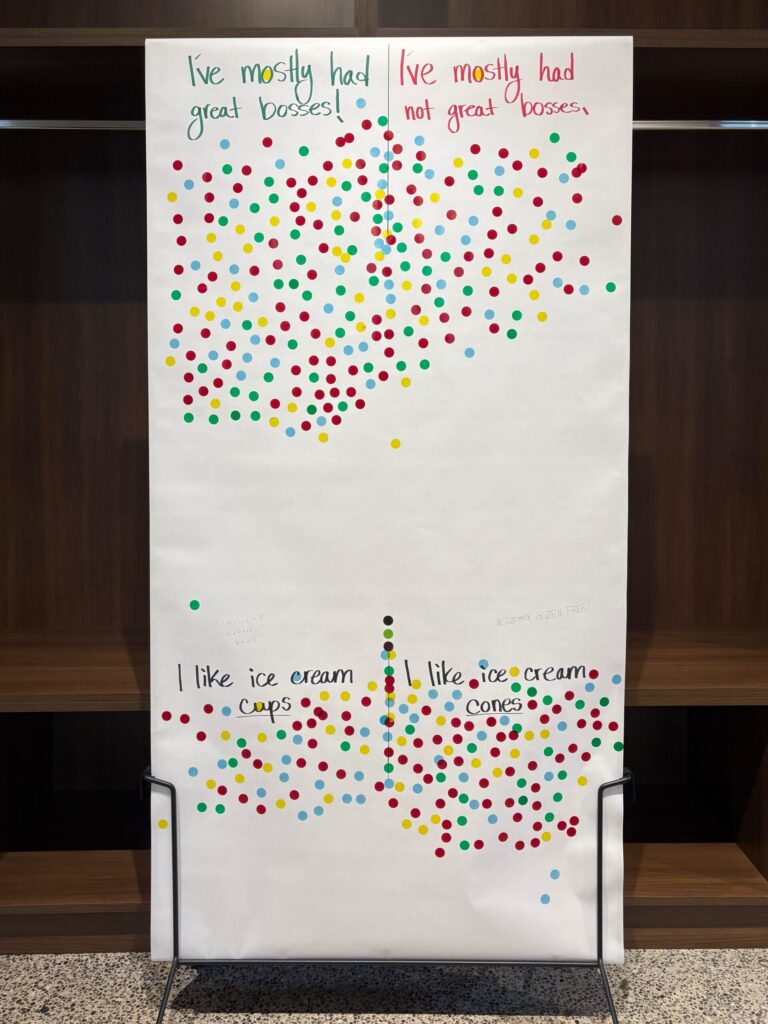
The results are pretty clear. What do you make of that? We’ve been talking about it since the first stickers went up.
One thing to take from it, particularly if you’re a boss right now, is that your people will usually try to meet you halfway. Honestly, many of the people we saw sweating the decision are ready to meet you much more than halfway. They are walking the ball to the 1-yard line. They want you to win so bad that they’re knocking down the first nine pins for you and putting the 10th on a 40º tilt. They’re lowering the greatness bar gently into the grass and placing helpful signs to ensure you don’t trip as you walk over it.
Sure, you may have someone on your team who’s gunning for you to fail, that happens, too. But the aggregate pattern is that people want work to be good, and will make a lot of space for bosses who are trying. The right response to that space and trust is not to slack off, the right response is to earn it. Management is a hard job and whether your team is running on clear expectations or vibes, we promise that they will have a better time, and so will you, if you know what you’re doing.
You may also see yourself in those bosses who acknowledged that they were someone else’s “not great” story. As a manager, it’s hard to look at these two columns and not ask yourself where your people would place you. If you’re reading this and wondering the same thing, what we’ll tell you is that those bosses were quick to say that they didn’t know what they were doing. That’s not really an excuse, in our books — if you’re cashing the paycheque you’re accountable for your work and your impact. But it’s an explanation, and the good news is that it’s curable.
And if there was one more thing we’d encourage you to take from this, it’s that it’s possible. Every left-side dot is a person who, for whatever the words mean to them, has had mostly great bosses. Managers have a huge impact on how we feel about work, and it’s possible for that to feel good, even if it doesn’t right now. Even if you are, today, squarely on the right hand side, that is moveable, and it’s not a pipe dream that you could feel differently. In our sample, however skewed it might be, great was actually the majority view.
Just don’t mess with their ice cream cones.
— Melissa & Johnathan